 PlatePilot
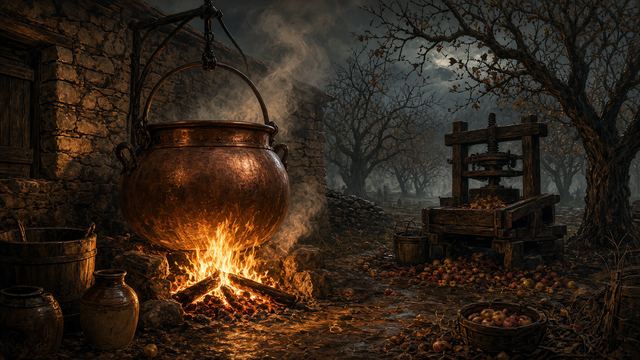
Copper Over the Orchard Fire
HistoricalAmericanEat the PastA Bite of HistoryStory5 Ingredients or Less
Ingredients
- Narrative chapter
Instructions
- 1By late afternoon the screw of the cider press had done its honest violence. Pomace lay in wet cakes, and the last cloudy runnings rattled into scalded barrels. In the yard behind a limestone farmhouse in the Pennsylvania German country, the air smelled of crushed Baldwin and Rambo apples, woodsmoke, and the iron tang of a kettle rim blackened by years of October work.
- 2Apples were not a garnish here. They were currency, drink, vinegar, winter sweetness, and hog feed. Nearly every holding kept an orchard; travelers noted that cider stood on tables more readily than water, which no one fully trusted. What the family could not drink fresh or hard would become vinegar for pickling, or be boiled down until it clung to a spoon.
- 3Liese tended the copper. It sat on a ring of stones over a steady fire, wide enough that two long-handled paddles were needed to keep the bottom from scorching. Into it went peeled quartered fruit—seconds and windfalls, never the perfect keepers destined for the cellar—and enough fresh cider to swim them. No one measured like a city cook. You added until the kettle looked right, then you stayed with it.
- 4Staying was the point. An apple-butter frolic was labor dressed as company. Neighbors arrived with crocks and children and gossip. Men rotated wood and spelled each other at the paddle; women judged color and thickness; someone set bread and cold pork on a board so the stirrers would not faint. The rule was simple and merciless: if you stopped stirring too long, the sugar in the fruit would catch and ruin hours of work. Scorched butter could not be saved by prayer or cream.
- 5As dusk came down, the mass in the kettle darkened from pale gold to a deep chestnut. That was pectin and caramelizing sugars doing what cooks in this valley had learned by inheritance. Some households loosened the pot with more cider; others, if trade had been kind, ventured a pour of molasses from the coastwise barrels that linked these inland farms to Caribbean sugar. Molasses was cash money made liquid—bought, not grown—so it went in carefully, a enrichment rather than a right. Spice, when it appeared, was thrift itself: cinnamon broken from a stick, a few cloves, allspice if the peddler had passed. Pepper and spice still marked a household’s reach.
- 6Liese’s younger brother fed the fire with split hickory and watched the surface plop like thick porridge. He had been told the old warning: apple butter is ready when a dab on a cold plate holds its shape and no ring of water bleeds out. Until then, keep the paddle moving in slow figures, scraping the copper’s bright belly. Children were allowed to lick the cooled test plate. Adults watched the sky.
- 7Preservation was the quiet politics of the season. Before frost locked the ground, the farm had to turn abundance into something that would not rot. Apples sliced thin hung on strings near the hearth to make dry “leather.” Cabbage rode toward the crock with salt. Pork would meet smoke and brine. But apple butter was the luxury of patience—fruit concentrated until a few spoonfuls could sweeten porridge, glaze a ham, or make cold rye bread feel like Sunday.
- 8By full dark the yard was only kettle-glow and the pale faces of people who refused to go home. Someone hummed a hymn tune without words. A dog circled the warmth. When the paddle finally left a clean wake and the butter shone a mahogany red-brown, Liese called for the crocks. They had been warmed so the shock of heat would not crack them. Hot butter went in layer by careful layer; a circle of paper dipped in brandy or vinegar was pressed to the surface in better-supplied kitchens, or simply a tight lid and a cold springhouse shelf. Sealed against air and idle fingers, the crocks would keep deep into winter.
- 9They ate standing up: thick smears on hearth bread still warm from the ashes, with slices of sharp stored cheese and onions. The cider in their cups was the same orchard in a lighter dress—tart, living, faintly sweet. No one needed a speech thrift. The lesson was in their shoulders and in the row of dark crocks cooling like banked coals.
- 10Tomorrow the field work would resume. Tonight the copper gave back the harvest in a form that would outlast the leaves. When Liese finally banked the fire, the smell clung to her dress and hair: apples, smoke, and the caramel edge of sugar coaxed out of fruit that might otherwise have gone to the hogs. In the springhouse, the butter waited—autumn reduced, ready for the knife and the plate.