 PlatePilot
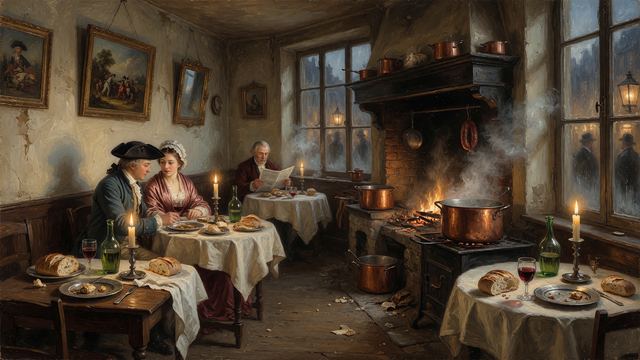
Restoratives on Separate Tables
HistoricalEat the PastA Bite of HistoryStory5 Ingredients or LessAmerican
Ingredients
- Narrative chapter
Instructions
- 1By dusk the street still smelled of wet stone and horse. Inside, the air was different: onion sweetness, the clean mineral steam of bones long simmered, butter catching on the rim of a copper pot. A man from the provinces stood with his hat in both hands, unsure where to put his body. In the house where he had grown up, supper meant one table, one hour, and whatever the kitchen sent. Here, strangers sat apart. A boy in a clean apron nodded him toward a small square of mahogany as if solitude at dinner were the most ordinary thing in France.
- 2On the table lay a card. Not a letter. Not a bill of lading. A list—dishes with prices beside them, written so a guest might choose. Bouillon. A fowl. A dish of eggs. A carafe of wine measured by the glass rather than swallowed as the household’s shared fate. He traced the words with a fingertip, half expecting a steward to snatch the liberty back. Before the 1760s, much of Paris had eaten under older rules: cookshop guilds guarded who might roast, who might stew, who might sell a finished dish to the street. Traiteurs fed parties by contract. Inns fed travelers at the common hour, at the common board. A man alone, wanting a restorative broth for his stomach and nothing else, had few doors that opened without argument.
- 3The room answered that problem with copper and glass. Great pots breathed along the wall—stock the color of pale amber, skimmed until the surface shone. The word restaurant itself still carried its older sense: a restorative, a fortifying liquor of meat essences meant to return strength to the weak, the studious, the newly arrived. What had begun as medicinal bouillon houses widened, after mid-century and especially as revolutionary years loosened corporate monopolies, into places where a diner could command a meal without belonging to a household kitchen. Private tables. A written choice. Service that came to you, not you to a boarding-house bell.
- 4He ordered the clear soup first. It arrived in a deep bowl, heat fogging his face, tasting of roasted bones, a whisper of carrot, salt placed with care rather than thrift’s desperation. In an age when meat was precious and spoilage a constant negotiation, a long-kept stock was thrift made elegant: every joint, carcass, and simmering hour stretched into spoonfuls that felt like wealth. Bread came in a clean crust—Paris bakers already famous for the daily loaf’s authority—and he broke it into the broth the way workers and clerks did, making the liquid a meal.
- 5Him the city rehearsed a new etiquette of appetite. A woman in a dark traveling cloak ate slowly, reading between bites. Two junior officers argued over a roast’s doneness without once asking a hostess what the house “was having.” The politics of the 1790s had not invented hunger, but they had cracked open who might sit where. Cooks who once worked only inside noble hôtels or under guild license found public rooms hungry for skill. Butter browned in pans. Herbs—thyme, parsley, a bay leaf fished out before plating—traveled from market gardens into sauces reduced until a spoon left a trail. Fat hissed on iron. The smell alone could stop a walker on the pavement.
- 6He advanced, daring, to a chicken—simple, roasted, its skin lacquered with its own juices—and a little dish of glazed onions that tasted of sugar’s slow patience and stock’s depth. Nothing here required a banqueting hall. The luxury was portion and timing: food arriving when he wanted it, hot, without a patriarch’s blessing or a landlord’s fixed hour. Wine, honest and not overcounted, cut the richness. He understood, dimly, that he was paying not only for flesh and bread but for the right to be unaccompanied and still properly fed.
- 7Night thickened on the panes. Candles doubled themselves in the glass. In the kitchen, beyond a swing of light, someone skimmed stock again for the next pot—tomorrow’s restoratives begun before tonight’s plates were cold. Outside, bakers would set dough for the four-o’clock oven; market women would stack leeks and roots in the dark. The old France of household hierarchies had not vanished. But on these small tables a different foodway had taken hold: appetite as a personal order, written down, priced, carried steaming from copper to cloth.
- 8He finished the last of the broth-soaked bread with a care that surprised him. The card still lay beside his knife, greasy now at one corner, a small charter of choice. Somewhere a ladle tapped the pot’s rim. The room exhaled onion, roast, and clean stock—the scent of a city learning that supper could begin whenever a stranger sat down and said, quietly, what he wanted.