 PlatePilot
Warm Rice, Cold Slice
HistoricalEat the PastA Bite of HistoryStory5 Ingredients or LessAmerican
Ingredients
- Narrative chapter
Instructions
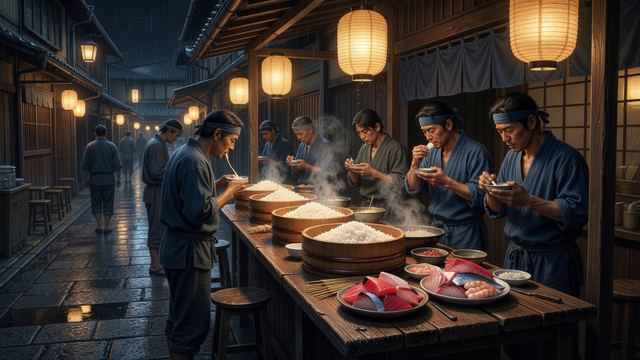
- 1By the third lantern after dusk, the stall’s cypress counter still held the day’s heat. Beneath it, wooden tubs of rice cooled just enough to take a handprint and keep it—warm, not steaming, grains glossy with a measured splash of rice vinegar, salt, and a little sugar. That balance was not a flourish. In a city without icehouses for every cook, acid and careful cooling steadied the rice so a working man could eat fish at night and walk home without regret.
- 2The fish had come up from Edo Bay before noon: small silver kohada, lean cuts of near-shore tuna, clams still tasting of tide. Men at the riverside markets rinsed, salted, and sometimes lightly cured what would not survive until morning. What Edo called edomae was not a restaurant concept; it was a geography. The bay was the pantry, and speed was the only honest spice.
- 3Kenzo worked the counter with wet hands and a blade wiped clean between fish. He was not famous. Fame belonged to names later retold—Hanaya Yohei among them—who, in these decades, helped turn an older idea on its head. For centuries, sushi had meant fish preserved with fermented rice: nare-zushi, a slow, sour compact of time and scarcity, rice often discarded after it had done its work. City life had no patience for that calendar. Vinegared rice could be ready the same day. Pressed under the palm into a two-bite mound, topped with a cool slice, it became supper for people who refused to sit.
- 4A clerk from a dry-goods shop arrived first, indigo jacket still dusty from shelves. He ate standing, elbows in, the way Edo’s crowds moved through bridges and alley markets. Soy waited in a shallow dish—not poured wildly, but touched. Wasabi, grated from a living rhizome when it could be had, cut through oil the way a clean knife cut through skin. Kenzo watched the man’s shoulders drop on the second piece. Hunger in this city was not always empty cupboards; it was the long day with no hearth waiting at a merchant’s counting table.
- 5Behind the stall, a charcoal brazier whispered under a rectangular pan. Tamago, the rolled sweet-savory egg, set slowly so it could be sliced into golden slabs for those who mistrusted raw fish or could not afford the better cuts. Egg was honest protein. It also stretched the stall’s reputation toward families: a child could be fed without ceremony while a father took tuna. On busy nights Kenzo’s niece brushed the tamago with a thin soy glaze that smelled faintly of mirin—sweet rice wine used sparingly, like a merchant’s compliment.
- 6Samurai did not rule this counter, though a low-ranking retainer might stop if the lantern light caught the sheen of a clean whitefish. Status still shaped diet across the shogun’s capital: elite tables ran to multi-tray kaiseki logic and seasonal restraint, while common streets ran to speed, vinegar, and whatever the boats had landed. Yet money blurred lines after dark. A successful rice broker could out-eat a proud man on stipend if the broker tipped well and did not argue the fat content of a cut.
- 7Preservation ruled every choice Kenzo made. Summer forced earlier curing and smaller batches. Winter let him keep rice a fraction softer, fish a fraction thicker. Nori, when he wrapped a piece, had to stay crisp—seaweed dried and toasted, a coastal craft as much as a garnish. Waste was a quiet shame. Rice left too hot turned gluey under the hand; rice left too cold refused to hold the fish. The craft lived in that narrow temperature, the same way a carpenter lived in the grain of wood.
- 8A late drizzle drove more bodies under the stall’s thin eaves. Someone laughed; someone complained prices—fish had climbed after a week of rough water, and vinegar was never free. Kenzo said little. He shaped, sliced, set pieces in pairs on a plain board. The city him was the largest in the world by some counts: a million mouths, canals, fire towers, and food hawkers calling through smoke. In that crush, a meal that required no floor cushion and no servant became a kind of mercy.
- 9When the last regular wiped his mouth with the back of his hand, Kenzo scraped the counter with a damp cloth that smelled of rice bran and old wood. A few grains clung to the edge of a tub, pearled and sharp with vinegar. He tasted one without thinking—everyday proof that Edo had taught rice a new job. Not slow fermentation in a village barrel, but a quick partnership with cold fish and night hunger.
- 10He banked the brazier. Tomorrow’s rice would be washed before dawn, drained, steamed in a heavy pot, turned out to cool under a fan while the bay’s catch was still being argued over at the water stalls. By lantern time the counter would be hot again, hands wet, slices precise. People would stand. They would eat with their fingers. And for a moment between work and sleep, the city’s appetite would narrow to warm rice and a cold, clean piece of the sea.