 PlatePilot
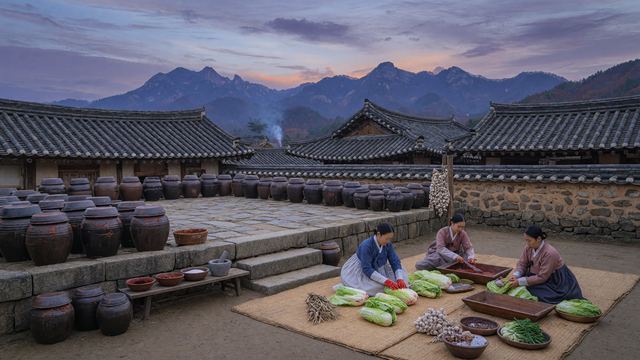
Jars Sealed Before the Frost
HistoricalEat the PastA Bite of HistoryStory5 Ingredients or LessAmerican
Ingredients
- Narrative chapter
Instructions
- 1By the third week after the full moon of the eighth month, the mountains above the village had already thinned to a clear, dry blue. Frost was still a rumor in the valleys, but everyone could smell it coming in the morning air—sharp as scraped iron. In the courtyards, cabbages stood in pale ranks like sleeping soldiers, outer leaves stripped, hearts rinsed until the water in the wooden troughs ran clear.
- 2Sun-ok knelt on a straw mat with her sleeves knotted high. Beside her, a stone mortar held yesterday’s work: dried red peppers, seeded and pounded until the powder clung to every crack in the basalt. Chili had not always been part of this labor. Village elders still told of grandmothers who salted cabbage with only garlic, ginger, and the brine of fermented shrimp and anchovy—jeotgal hauled inland from the southern coast in heavy crocks. Then, sometime after the foreign red pods arrived by way of the southern ports in the late 1500s and took root in Korean soil, the paste changed color. By Sun-ok’s day, gochugaru was wealth you could smell: bright, smoky, slightly sweet, and expensive enough that a poor household measured it by the handful, not the scoop.
- 3Her mother-in-law inspected the brine. Cabbages had spent a night under coarse sea salt, weighted with clean river stones so the leaves softened without rotting. Too little salt and the leaves would sour wrong before deep winter; too much and the finished kimchi would taste of the ocean’s punishment. The older woman tasted a rib, nodded once, and tipped a ladle of sticky rice porridge into the chili paste to bind it—starch to help the seasoning cling through months in the dark.
- 4Men carried water. Children fetched garlic by the braid and green onions still gritty from the kitchen plot. A neighbor from three roofs over brought a bowl of fermented shrimp so pungent it made the dogs sit up. Kimjang was never only one family’s work. In late Joseon countryside, winter survival was a shared arithmetic: enough banchan to stretch barley and rice when the fields slept, enough vitamin-bright crunch when fresh greens vanished under ice. A prosperous house might put down dozens of onggi—those breathable earthen jars with their belly curves and fitted lids—while a tenant farmer’s wife counted jars on one hand and prayed the freeze came late.
- 5They worked bare-handed. Chili burned under the nails and along the wrists until the skin shone raw and honest. Sun-ok packed paste between every leaf layer of a halved cabbage, folding it closed like a letter no one would open until hunger demanded. Whole radishes, cubed and tossed in the same red mixture, went into separate jars for dongchimi’s sharper cousin. Someone laughed when a child sneezed a cloud of pepper dust; someone else hushed the yard when the local yangban’s steward passed on the lane, eyeing the spread as if counting tax in vegetables.
- 6By late afternoon the jangdokdae—the raised platform behind the house—held its winter regiment. Onggi jars were wiped, filled, and settled on the stone so air could move under them and rain could drain away. A few would be half-buried later, crowns above the soil, to keep a steadier cold once true frost locked the ground. Fermentation was a slow treaty with microbes no one could name but everyone trusted: lactic tang rising week by week, cabbage sweetening then sharpening, the paste mellowing from raw fire into something deep enough to wake a bowl of plain rice gruel on a January morning.
- 7When the last jar was lidded, Sun-ok scrubbed her arms in cold well water until the worst of the red ran off. The courtyard smelled of garlic, sesame oil from a final gloss on a test bowl, and the clean mineral scent of wet clay. Inside, a pot of doenjang-guk simmered with soft tofu and young cabbage trimmings—the scraps too pale for the jars but too precious for the pigs. Rice steamed. Someone set out roasted barley tea.
- 8They ate the first tasting standing up, still in work clothes: a few leaves of the new kimchi, still more salt than ferment, beside hot rice and a spoon of the day’s soup. It was not yet the deep, complex kimchi of midwinter. It was a promise—acid and heat waiting in the dark, stacked against scarcity, sealed before the frost could dictate the terms. Outside, the onggi cooled under a sky turning indigo. Inside, the table held enough color to make the coming cold feel negotiable.