PlatePilot
Oysters Under the Gas Jets
Every recipe here is free to read.
HistoricalAmericanEat the PastA Bite of HistoryStory5 Ingredients or Less
Ingredients
- Narrative chapter
Instructions
- 1Before dawn the skiffs worked the flats like slow needles. Men in salt-stiff coats tonged oysters from the muddy bottoms of the Narrows and Jamaica Bay, the poles biting, the rakes lifting clusters black with weed. A cold wind came off the Upper Bay and found every gap in a collar. The catch went into baskets, then into sloops that nosed toward the slips while the city was still mostly chimneys and fog.
- 2By mid-morning Pearl Street remembered why it had its name. Shell heaps had once paved and filled whole blocks; the city had quite literally risen on discarded armor. Now wagons rattled over cobbles with barrels stenciled for Bluepoints and Rockaways, ice sweating between the staves when the season ran warm. A boy with a sack of oyster crackers trotted behind a vendor whose cry cut the traffic—“Oys! Oys alive!”—and clerks on errands bought six for a penny when the beds were generous, eating them standing, liquor bright on the wrist.
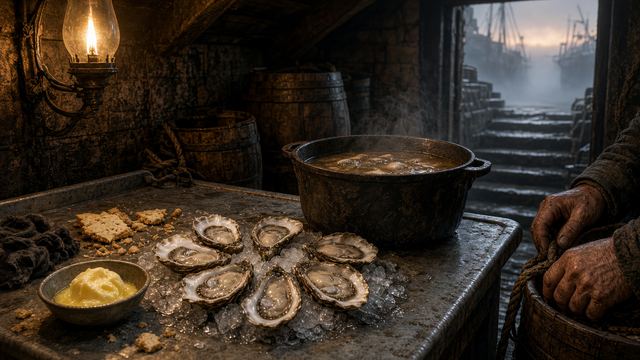
- 3Down three stone steps, out of the wind, the cellar kept its own weather. Gas jets hissed in wire cages and threw a yellow that made the zinc counters look wetter than they were. The air was brine, coal smoke, melted butter, and the sharp green of chopped pickle. A woman named Kate—who had learned the trade from an uncle who shucked for the Fulton stalls—ran a narrow room with sawdust underfoot and a pot that rarely left the back range. She did not sell fashion. She sold fullness.
- 4A stevedore came in with rope burns on both palms and the patience of a man who had moved cotton all morning. He did not ask for raw on the half shell, though the iced tub by the door held them, flat side down, knives ready. He asked for stew. Kate’s stew was milk and oyster liquor brought just short of a boil, never a hard rolling that would toughen the meat; a lump of butter dissolved into a gold slick; white pepper; oysters slipped in at the last so they went from translucent to just-set. Crackers waited in a cracked bowl—thick, dry, meant to be crushed by the spoon until the bowl turned almost to porridge. That was the point. Oysters were cheap protein in a growing port, and crackers stretched them without apology.
- 5At the next elbow a clerk in a darned coat ordered fried. The pan was iron, the fat hot enough to seize crumbs at once. Kate dredged the meats in cracker meal, sometimes a dusting of flour if the barrel allowed, and the crust went bronze while the centers stayed tender. A splash of vinegar and a grind of black pepper finished them. No ceremony. In better rooms uptown, scalloped oysters might meet cream and a spoon of sherry under a browned top; here the luxury was simply that a laborer’s coin bought the same harbor creature a merchant might eat after the Exchange closed.
- 6Outside, the trade kept its wider machinery turning. Shuckers—many of them women and free Black workers in a city of complicated freedom—stood at stalls with thick gloves and short knives, opening for the raw trade and for packing. Meats went into kegs and cans; liquor was saved because cooks knew its value; shells piled again, endless. Ice from the Hudson harvests and the big New England houses lined barrels so oysters could ride the new rails inland, still smelling of the Sound when lids came off in Ohio dining rooms. What had been local became a commodity chain: tongs, sloop, stall, cellar, freight car.
- 7Kate wiped the zinc and watched the afternoon shift change. Someone argued, soft, whether the Jamaica beds tasted sweeter after a rain. Someone else complained that sewage and over-tonguing were muddying grounds that had seemed endless in their grandfathers’ time. They were not wrong. The same harbor that fed the cellars was beginning to poison them; within a generation maps of “safe” beds would shrink, and the penny luxury would turn dear or dangerous. But on this day the pot still steamed, and the gaslight still made butter look like wealth.
- 8Near closing she set out a last pan—oysters roasted in their shells with a dab of butter and crumbs until the edges curled—and the smell rose up the stairwell into the street. Men slowed. A child was handed a cracker soaked in stew liquor and went quiet with concentration. The city above them was counting cargo and climbing stories of brick. Below, for a few more hours, the table was still the harbor’s: salt, fat, milk, heat, and the soft meat that had built streets on its own empty shells. Appetite, in that yellow light, felt like a kind of civic memory—something you could still taste before the beds gave out.