PlatePilot
Berries Sealed in Summer Fat
Every recipe here is free to read.
HistoricalAmericanEat the PastA Bite of HistoryStory5 Ingredients or Less
Ingredients
- Narrative chapter
Instructions
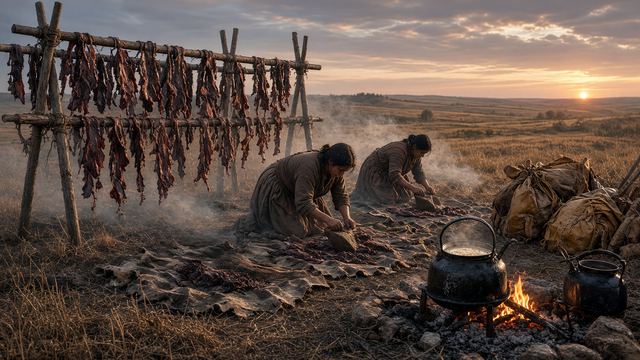
- 1By late September the herds had thickened on the open grass, and the camp woke to the smell of fat before it woke to coffee. Women were already at the drying racks—long frames of peeled poles leaning into the wind—turning thin sheets of buffalo meat the color of old mahogany. Flies kept their distance where smoke from green willow curled. Somewhere a child sang to keep time with the stone pestle.
- 2This was the season that decided winter. Hide, bone, sinew, and tongue all mattered, but the true wealth of the northern plains hunt was denser than any robe: pemmican, the pounded ration that could travel farther than fresh meat ever would. Métis brigades and their kin worked in practiced chains. Men rode and butchered. Families sliced the flesh along the grain into sheets no thicker than a belt. Sun and steady air did the rest, drawing moisture out until the meat snapped instead of tore.
- 3Beside the racks, kettles muttered. Marrow bones and suet went in first, then the richer back fat, rendered slow so it would not scorch. Clean fat was life insurance. Without it, dried meat alone scraped the gut and left a paddler weak on the portage. With it, a man could work fourteen hours on the lakes and still sleep without cramps. Traders for the Hudson’s Bay Company and the North West Company knew the arithmetic cold: a pack of pemmican was concentrated summer, measured in pounds that behaved like days.
- 4When the sheets were ready, they came down. On hides spread over prairie sod, women and older girls took up stone hammers and mauls and began the long percussion—thud, thud, thud—breaking fiber into a coarse, fibrous meal. Dust of meat rose and settled on wrists. Into that meal went the fat, still warm enough to pour, and with it dried Saskatoon berries or chokecherries saved from July. The fruit was not garnish. Tart skins cut the grease, added a whisper of sugar, and helped the mass keep. Salt appeared when someone had trade stock; often the meat’s own seasoning and the smoke were enough.
- 5They packed the mixture while it could still take a print from a thumb. Rawhide bags—sometimes stitched from the green hide itself—received the hot blend. As it cooled it set into a dense loaf that would neither weep nor crumble if the seal held. A good bag might weigh ninety pounds. Stacked in a canoe, such bags became ballast and breakfast both. At a rough camp on a granite shore, a voyageur would carve a block with his knife, soften it near the fire, and eat it plain or boiled into a thick soup with a little flour if the bourgeois had been generous.
- 6Scarcity ruled the calendar elsewhere. Up at the posts, pork from the Atlantic barrels arrived brine-white and expensive. Corn and peas stretched stews. But the brigades that ran the long water—from the Red River country toward Lake Superior and the bay—moved on buffalo fat more than on any European hog. Competition between companies sharpened the demand until pemmican was not merely food but a lever of power. Camps that could produce surplus sold it; camps that could not felt winter early.
- 7Technology here was hand and weather. No tin retort, no patent canner—only rack, kettle, stone, and hide. Preservation meant removing water, sealing what remained in fat, and keeping air and damp outside the bag. Done right, the ration lasted months and tasted of smoke, iron, and dark berry. Done wrong, it soured and shamed the maker. Children learned early to watch the color of the fat and the snap of the sheet.
- 8Toward evening the wind shifted cooler, a reminder that the herds would soon thin and the canoes would have to turn. Someone laid a fresh sheet closer to the coals so the edge crisped. Another scored a cooled bag and offered thin shavings on a tin plate—dense, glossy, flecked with berry like night sky. Men fresh off the hunt ate standing. The fat shone on their fingers. In the last light the drying racks stood like narrow sails against the grass, and the whole plain smelled of rendered summer.
- 9What left that camp did not look like a feast. It looked like freight. Yet every pound carried the work of an entire season: the ride, the blade, the sun, the stone, the berry patch, the careful pour. Far down the water routes, when rain stitched the lake and hard bread turned to paste, that same freight would be the hour’s comfort—cut, warmed, and eaten close to the fire—proof that the plains had been generous while there was still time.