PlatePilot
Crimped Edge Against the Dark
Every recipe here is free to read.
HistoricalAmericanEat the PastA Bite of HistoryStory5 Ingredients or Less
Ingredients
- Narrative chapter
Instructions
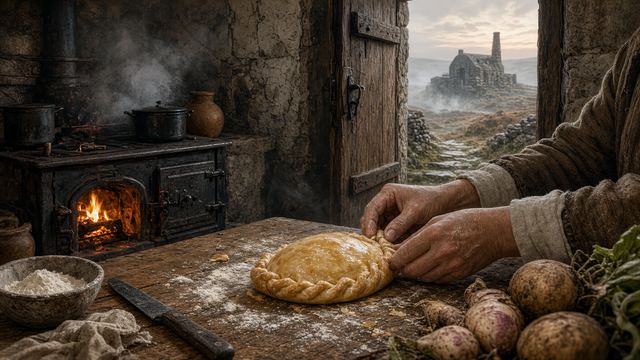
- 1Before the engine house woke fully, the kitchen already had. Fat had begun to gloss the underside of a cast-iron griddle. Flour dusted the deal table like a light fall of china clay. Mary pressed her thumb along a half-moon of dough, trapping stew inside as if sealing a letter no postman would ever open.
- 2The filling was not luxury. It was arithmetic. Diced beef—when there was beef—cut small so a little went far. Potato, swede (what some called turnip), onion: the cheap ballast of a miner’s day. Pepper enough to wake the tongue after hours of damp. Salt to keep the meat from turning sour in the heat of a man’s coat. No gravy slopped free; the pastry had to hold. A free steam vent or a weak crimp meant a ruined dinner and a hungry man at the two-hundred-fathom level.
- 3She crimped with a practiced braid of finger and knuckle—the rope edge that made a Cornish pasty look like itself. At one end she pinched a letter: J for John. Initials were not romance. In the dark, among dozens of identical bundles set on a timber or hung in a flannel, a man found his own by touch. Some wives marked with a fork prick, some with a twist. Everyone knew the rule. You did not eat another man’s pasty.
- 4Outside, the stack smoked against a gray Atlantic sky. Cornwall’s granite was honeycombed with old workings; copper had boomed and waned, tin still pulled boys out of school and fathers into the cage. The mines ran on steam and muscle and candle. Wet levels dripped. Air grew thick. Arsenic and mineral dust clung to skin and nail. That was why the thick crimped rim mattered twice over: it was a handle. A miner could hold the dirty edge with blackened fingers and eat inward toward the clean meat, then throw the crust to the rats—or so the story went, repeated until it hardened into local truth.
- 5John took the pasty wrapped in cloth, still warm against his ribs as the man-engine or the ladder-way swallowed him. Midday underground was not a table. It was a pause on a plank, boots in standing water, the pasty opened like a book. The first bite released steam that smelled of onion and pepper and the cheap cut that had stretched a week’s wages. Men ate with the haste of those who knew a core-shift left little mercy. Some saved a corner for the long climb up. Some traded a bite for a twist of tobacco. Food was currency when coin was short.
- 6Above ground, the same pastry fed surface workers and families on feast days, but its fame was born of scarcity and shaft depth. A good pasty was portable heat: no bowl to break, no spoon to lose, no broth to spill down a ladder. Pastry sealed moisture in and dirt out. In lean weeks the meat vanished and the pasty became potato and onion alone—still called a pasty, still crimped, still marked. When pilchards ran or a neighbor slaughtered, the filling brightened. When prices rose after a bad season, the beef shrank to flavoring.
- 7By evening the kitchen smelled of damp wool and reheated drippings. Mary set leftover pastry edges to crisp beside the fire and listened for boots. The mine took lives in falls and flood; it also took appetites and gave them back ravenous. On a good night there might be tea strong enough to stand a spoon, bread, a scrap of cheese, the last of the onion browned soft. On a better night—rare as a dry level—someone brought home a bit of cream or a mackerel from the coast road.
- 8But the center of the day remained that sealed half-moon carried into the dark. Flour, lard or dripping, root and onion, a little beef if fortune allowed, pepper like a small luxury, a name pressed into dough. When John broke his open at depth, the mine for a moment smelled not of powder and wet rock but of a kitchen that had risen before dawn—to send heat, and a mark, and enough supper to climb back out toward the table.