PlatePilot
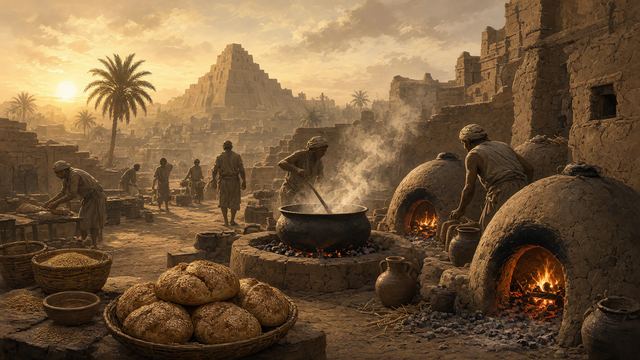
Rations Marked in Clay
Every recipe here is free to read.
HistoricalAmericanEat the PastA Bite of HistoryStory5 Ingredients or Less
Ingredients
- Narrative chapter
Instructions
- 1The first light did not come from the sun. It came from the bakery ovens of the temple quarter, a low orange breath against mud-brick walls while the Euphrates still held the night. Ninsun wiped ash from her wrists and listened for the grinders. Barley had to be crushed before the scribes arrived with their damp clay, or the whole morning’s wages would run late.
- 2She worked under the shadow of a ziggurat whose terraces caught the earliest gold. This was not a feast kitchen. It was an engine. Brickmakers, canal diggers, temple dependents, and boat haulers lived on what the storehouses released: loaves ranked by fineness, jars of thick beer counted like coin, onions, dried fish when the river ran generous, and dates sticky enough to glue a thumb to a tablet. A laborer’s day could be tallied in sila of grain and beer as cleanly as a field in reeds. The clay remembered what the stomach forgot.
- 3Ninsun’s station was the great pot line. Fat—sheep-tail when the flocks had been good, plainer drippings when they had not—went in first, then chopped leeks and onions until the air stung. Water followed, cloudy from the canal settling jars. crushed coriander seed, mustard, and garlic went after, then chunks of mutton for the higher tables and bones and tougher cuts for the work gangs. The Yale-style recipes later ages would puzzle over were not poetry. They were procedure: water, fat, meat, aromatics, a measured patience. Beer sometimes went into the pot as well, sour and brown, softening sinew the way a good steward softened a dispute.
- 4Across the courtyard the bakers slapped dough onto hot interior walls of the ovens. Barley for the many, emmer wheat for those whose names sat higher on the lists. The loaves came out dense, blistered, meant to travel in a sling of cloth to the brick face or the barge. No one called bread sacred here in the way later ages would argue theology over crumbs; bread was the contract. You raised walls for the city, and the city answered in crust and jar.
- 5A junior scribe named Belshunu arrived with a board of soft tablets and a reed stylus behind his ear. He did not look at the steam. He looked at quantities. Twenty loaves of the coarser sort. Beer of the second quality, still yeasty enough to be called liquid bread. A string of dried fish. Onions. A measure of date syrup for the overseer’s household. He pressed signs into clay while the smell of seared fat tried to rewrite his numbers. Ninsun watched him seal one tablet with a rolled impression and set it to dry on a reed rack. Tomorrow that little brick of writing might travel farther than the stew.
- 6Scarcity taught the menu more than luxury ever did. When floods spoiled grain, the pots leaned harder on pulses—lentils and chickpeas boiled soft with onion and a shine of oil. When herds thinned, fish from the marshes took the center, split and dried on frames above the mudflats, or fresh and grilled on river stones. Sesame paste enriched sauces for those who could claim it. Salt was careful, not casual. Nothing of the pig’s New World cousins, nothing of the tomato’s red, nothing of cane sugar’s later empire—only what the alluvial plain, the sheepfold, the date garden, and long-distance caravans of rarer aromatics allowed.
- 7By midmorning the first gang broke for their ration. Men sat on their heels in a strip of shade, tearing barley loaf, tipping beer, chasing onion sweetness through mutton broth with their fingers. Talk ran to water levels and which canal gate stuck. No banquet speeches. The feast politics of Mesopotamia lived higher up, in palace courtyards where rarer meats, finer breads, and fruits arranged like tribute told guests who held the river. Down here the politics were simpler: empty jar, full jar.
- 8Ninsun kept a small dish back for the girls who turned the querns—hot bread torn open, a spoon of the better stew, three dates pressed flat. Fat shone on their knuckles. The grinders’ shoulders would ache by dusk, but the body understood payment in warmth and salt better than in words.
- 9When the sun finally cleared the temple’s upper stage, the ovens were already into their second firing and the stew pots had been topped again. A breeze off the water lifted chaff and the clean mineral smell of wet clay. Belshunu stacked his dried tablets like a tiny wall. Ninsun skimmed a skin of fat from a cauldron and set it aside for the evening’s second service, when cooler air would bring larger appetites and the city’s noise would settle into the scrape of bowls.
- 10Hunger here was not an accident. It was administered, baked, sealed, and poured. And every loaf that left the courtyard carried the same quiet lesson the river taught the fields: civilization was a kitchen that had learned to count.