PlatePilot
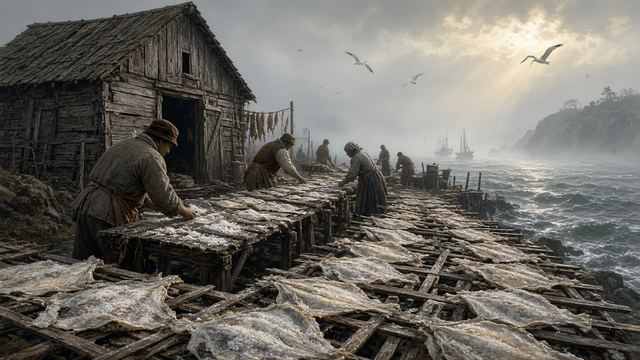
Salt Snow on the Flakes
Every recipe here is free to read.
HistoricalAmericanEat the PastA Bite of HistoryStory5 Ingredients or Less
Ingredients
- Narrative chapter
Instructions
- 1Before the fog burned off the harbor, the stages were already wet with work. Timber platforms jutted over the tide on spruce piles, slick with scales and the night’s chill. Men hauled barrows of fish up from the boats—Atlantic cod, some still flexing, most stunned cold from the hold—and dumped them onto the splitting table as if emptying sacks of silver.
- 2A boy no older than twelve took the throats. His knife knew the path: behead, open the belly, drop the liver into one tub and the sound (the swim bladder) into another. Next to him a splitter worked with a heavier blade, one cut along the backbone, a twist, and the fish opened like a book. The thick white flesh went face-down into coarse foreign salt—Lisbon and French salt when the merchants could get it, sharper and drier than the damp local stuff—and the pile rose into what the shoremen called salt snow.
- 3Nothing here was wasted if a buyer existed. Tongues and cheeks were set aside for the cookhouse. Livers would be rendered slowly for oil that greased boots, lamps, and the hinges of every door in the outport. Heads boiled down into a gluey broth that stuck to ribs when biscuit alone would not. Even the lazy thrashing of gulls over the offal piles was part of the ledger; the birds cleaned what the tide did not.
- 4By late morning the split fish, having taken salt, were rinsed in seawater and laid out on the flakes—broad racks of spruce boughs raised knee-high so air could walk underneath. Women and older children turned them with wooden paddles. Too much sun and the flesh cooked and soured; too much fog and mildew bloomed gray-green along the edges. A good day meant a hard clean wind off the Atlantic, the kind that pulled moisture out of the fish until the surface went pale and leathery. Merchant agents walked the rows like surveyors, pinching edges, sniffing for the sweet-rot that meant a rejected cask.
- 5This was not a homestead harvest. It was an Atlantic machine. English and West Country ships had been coming for the summer fishery for generations; by the mid-eighteenth century permanent outports clung to the coves, indebted to mercantile houses that advanced salt, twine, flour, molasses, and salt pork against the autumn tally. A quintal of well-cured dry cod—a hundredweight—paid debts, bought nails, and decided whether there would be new netting next spring. Poor cure meant a docked price in Bilbao, Lisbon, or the West Indies, where salt fish fed enslaved sugar workers who could not be spared garden time.
- 6In the cookhouse at dusk the iron pot told a different story from the export casks. Fresh cod cheeks seared in pork fat until the edges crisped. Tongues simmered with a scrap of onion if the briny barrel still held any. Hard biscuit, ship’s bread softened in the broth, stretched the meal. Molasses, dark and mineral, was spooned into mugs of weak tea—the cheap sweetness of the triangular trade, sticky on children’s mouths. Fat cooled in a rim the pot; someone ran a finger through it and licked the salt.
- 7An older splitter wiped his hands on a sacking apron and watched the flakes pale under the long light. He had seen cargoes condemned for a week of wrong weather. He had also seen a clean, hard cure stack into holds like white timber, bound for Catholic fast days in Europe and plantation kitchens in the Caribbean. The fish on the racks were money, religion, empire, and winter all at once.
- 8When the last row was turned and covered against night damp with birch bark and old sail, the shore crew ate standing. Steam lifted off the bowls. The meat of the cheeks was sweet in a way salt fish never would be again once it left this harbor. Outside, the flakes waited for morning wind. Inside, grease shone on the rim of a shared spoon, and every person at the table understood the same arithmetic: what dried white under tomorrow’s sky would travel farther than any of them ever would—and what stayed soft in the pot was the only true wage of the day.