PlatePilot
Summer Corked for the March
Every recipe here is free to read.
HistoricalEat the PastA Bite of HistoryStory5 Ingredients or LessAmerican
Ingredients
- Narrative chapter
Instructions
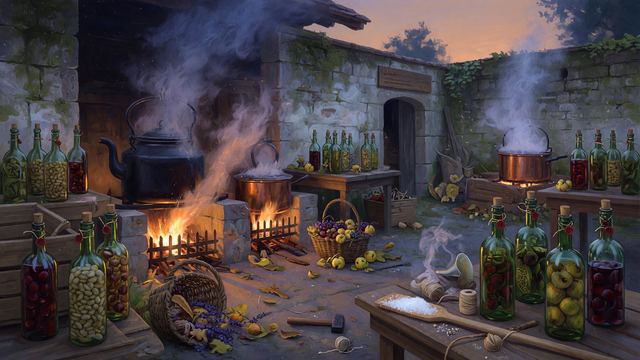
- 1The copper kettle in the courtyard at Massy had been singing since dawn. Steam braided upward into a September sky still soft with late garden heat, and inside the wide glass bottles—thick-walled, greenish, mouths broad enough for a whole small pear—green beans stood upright like tiny soldiers. Nicolas Appert moved among them the way a confectioner moves among sugar work: exact, unsentimental, listening for the moment when heat had done enough and not too much.
- 2France needed what he was selling. Armies on the Rhine and in Spain marched on hard biscuit, salted beef that greened at the edges, and soup boiled from whatever a foraging party could seize. Ships of the line carried barrels of brine and weevils. The Directory, then the Empire, had offered a public prize—twelve thousand francs—for anyone who could keep meat, milk, and vegetables sound for months without the ruinous cost of ice or the harshness of heavy salt. Appert, who had cooked and sugared for private tables, answered not with theory but with cork, twine, and boiling water.
- 3He filled the bottles nearly to the shoulder: young peas still sweet, cuts of veal in their own jelly, broth reduced until a spoon left a clean track. He drove corks hard, bound them with wire or cord, and sometimes painted the seal with a pitch composition so air could not cheat its way back in. Then the bottles went into the bath. Water climbed; the glass trembled; the kitchen smelled of wet cork and cooked greenness. He timed the immersion by the substance—longer for meat, shorter for delicate fruit—because he had learned, bottle by bottle, that heat locked the season if the seal held.
- 4He did not yet have Pasteur’s name for why it worked. He had only failure and success stacked on shelves. A cloudy bottle meant spoilage and wasted wages. A clear one, opened months later on a winter table, meant asparagus that still tasted of May. Visitors from the navy came to watch. Officers who had eaten ship’s biscuit until their gums ached lifted lids and went quiet at the sight of pale beans in liquor, or cherries dark as ink, or a pâté that had not turned.
- 5In the fields beyond Massy, harvest carts creaked. Kitchen gardens gave up the last firm tomatoes, the cabbages beginning to heart, herbs still sharp before the first real frost. Appert’s workers trimmed, blanched, packed. The work was not romantic. Fingers pruned strings from beans until they blistered. Glass cracked if the bath leapt too fast. A bad cork meant a night’s labor souring in the corner like a rebuke. Yet the shelves filled—rows of captured summer destined for magazines, ports, and the long roads behind the eagles.
- 6On campaign, a sealed bottle was politics as much as supper. A general who could set green vegetables beside salt meat fed more than bellies; he fed the idea that the Empire could outlast distance. Sailors who cracked a jar of mutton in gravy after weeks of hardtack tasted, for an hour, the mainland they had left. Spoilage had always been the quiet enemy—worse than weather, sometimes worse than shot—because hunger unstitched discipline. Appert’s method did not end scarcity. It rearranged it. What had been perishable became portable. What had been local became logistics.
- 7By 1810 his treatise was in print, the prize paid, imitators already experimenting with tinplate canisters for rougher handling at sea. The glass remained the proof of concept: you could see the food, trust the clear liquor, watch for the betraying cloud. In Paris shops, preserved soups and vegetables began to appear for bourgeois pantries as well as for the war office—luxury framed as thrift, summer sold in winter by the bottle.
- 8Evening cooled the courtyard. Appert lifted one jar from the bath with padded cloths and set it to rest. Inside, the beans settled. The cork held. Tomorrow there would be pears in syrup, and a trial of milk that still made him nervous, and letters asking how long a frigate might keep a case unbroken. He wiped steam from his brow and caught the faint smell of cooked garden still rising from the kettle—green, ordinary, and suddenly strategic.
- 9When such a bottle finally reached a scrubbed deal table, whether in a captain’s cabin or a provincial kitchen months from harvest, the first pour was the point of the whole invention: broth or beans or fruit spilling out as if the road and the months had never happened. Hunger leaned in. Spoons waited. The march, for a moment, tasted of home ground.